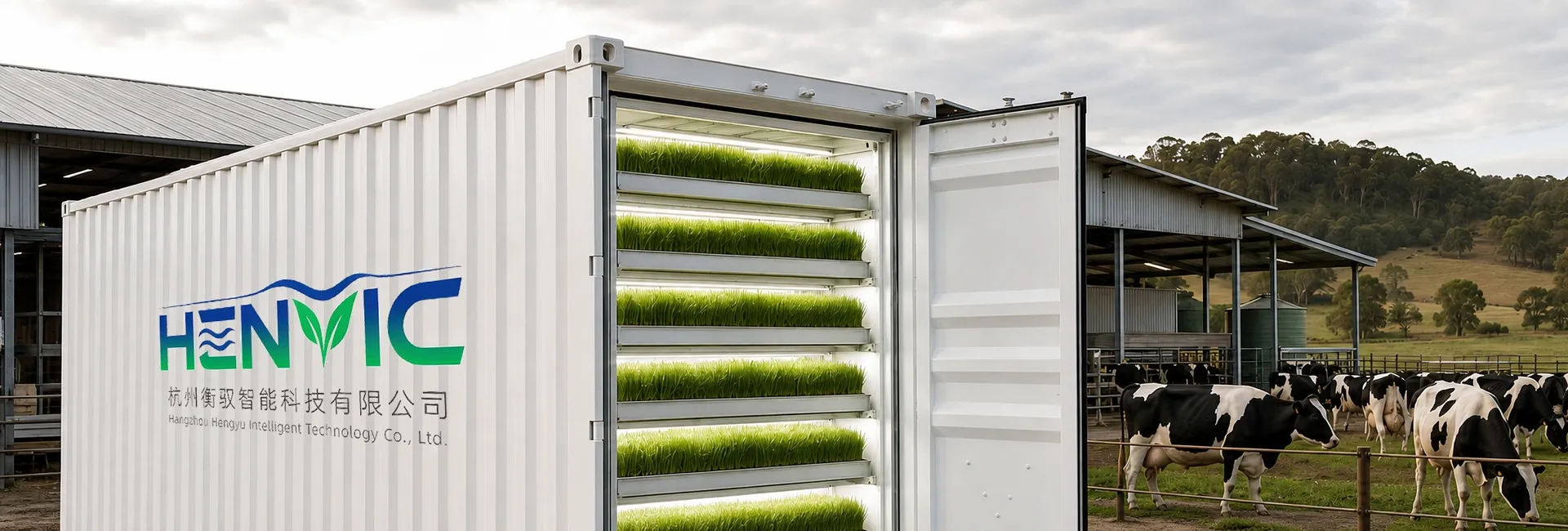
A container farm is a thermodynamic device before it is an agricultural one. Everything that happens inside the box — how fast the plants grow, how much water they drink, where the mould appears, how much the electricity bill comes to — follows from a small set of physical relationships. Understanding them is what separates a facility that produces consistently from one that produces intermittently.
Replacing the sun
Outdoors, plants receive a daily light integral that varies with latitude, season and cloud cover, and a spectrum that is broad but not optimised for any particular crop. Indoors, both become design parameters.
The quantity that matters for growth is the daily light integral, or DLI, expressed in moles of photosynthetically active photons per square metre per day. Lettuce is content with 12 to 17 moles; herbs such as basil want 15 to 25; fruiting crops like tomato and strawberry require 20 to 30 or more. The DLI is the product of the photosynthetic photon flux density, measured in micromoles per square metre per second, and the photoperiod in seconds. A fixture delivering 250 micromoles per square metre per second over an 18-hour photoperiod yields a DLI of about 16.2, which suits leafy greens.
The reason this matters is that DLI is not a soft preference. Below the crop's requirement, growth is proportional to light; above it, additional light produces diminishing returns and eventually photodamage. A container farm that under-lights its crop will not be saved by better nutrition or tighter climate control, because carbon assimilation is the bottleneck.
Spectrum is the second lever. Chlorophyll absorbs most strongly in the blue near 450 nanometres and the red near 660 nanometres, and modern horticultural fixtures concentrate their output there because photons at those wavelengths are used most efficiently. But a purely red-blue spectrum produces abnormal morphology: leaves that are thin, stems that are elongated, and in some species, a failure to develop properly. Far-red at 730 nanometres triggers the shade-avoidance response and can be used deliberately to control plant height; green light penetrates deeper into the canopy and can improve light distribution to lower leaves; ultraviolet exposure at low doses stimulates the production of secondary metabolites such as anthocyanins and flavonoids, which matter for flavour and for the functional-food market.
The engineering constraint is efficacy, the micromoles of photons produced per joule of electrical input. Current commercial fixtures achieve 2.5 to 3.5, with the best laboratory devices higher. Because the entire light load becomes heat inside a sealed box, higher efficacy reduces both the electricity bill and the cooling load simultaneously — a rare case where efficiency improves two cost lines at once.
The leaf boundary layer
Light is necessary but not sufficient. Carbon dioxide must reach the chloroplast, and it arrives by diffusion through a boundary layer of still air that clings to every leaf surface. The thickness of that layer depends on air velocity: in still air it can be several millimetres, which is enough to halve the CO2 concentration at the stomatal opening compared with the bulk atmosphere. Horizontal airflow of 0.3 to 0.8 metres per second over the canopy thins the boundary layer substantially and consistently improves growth.
This is why airflow design inside a container is not merely a matter of cooling. It is a matter of ensuring that every tier and every position along a channel receives roughly the same air velocity. The failure mode is well understood: in an under-designed box, the plants nearest the cooling coil or the supply duct transpire and grow faster than those in the dead zone at the far end, and the batch becomes non-uniform. Because the harvest is usually a single cut per channel, non-uniformity translates directly into waste.
Water vapour and the disease threshold
Transpiration is driven by the vapour pressure deficit, the difference between the saturation vapour pressure at the leaf's internal temperature and the actual vapour pressure of the surrounding air. It is expressed in kilopascals, and it integrates temperature and humidity into a single number that reflects what the plant actually experiences.
Below about 0.4 kilopascals, transpiration becomes too slow. The consequences are not obvious at first: growth slows, and more seriously, calcium — which moves in the plant almost exclusively in the transpiration stream — fails to reach the growing tips, producing tipburn in lettuce, blossom-end rot in fruiting crops, and brittle new growth in herbs. Meanwhile, the leaf surface remains wet for extended periods, which is precisely what Botrytis cinerea requires to germinate. Above about 1.2 kilopascals, the plant closes its stomata to conserve water, photosynthesis falls, and the crop is effectively drought-stressed despite standing in a nutrient solution.
Holding VPD in the 0.6 to 1.0 kilopascal band is therefore a physiological requirement, not a comfort setting. In a sealed box the available levers are cooling (which lowers temperature and raises relative humidity), reheating (which lowers relative humidity at constant absolute moisture), and ventilation (which exchanges moisture with outside air). Each has an energy cost, and the control strategy chosen determines whether the box spends its energy on cooling or on dehumidification. Conventional on-off control oscillates VPD around the setpoint and wastes energy; model-predictive or coordinated control that modulates cooling, reheating and ventilation together achieves the same VPD with materially less electricity.
Condensation: the quiet adversary
Wherever an interior surface falls below the dew point of the adjacent air, water appears. In a container farm this happens at the cooling coil, on uninsulated pipework, at thermal bridges in the envelope, and on the underside of the roof during the lights-off period as the air cools. The consequences are cumulative and expensive. Standing water on horizontal surfaces becomes a reservoir for algae and for pathogens. Repeated wet-dry cycling on the steel shell drives corrosion. Ice forming at a cold bridge degrades the insulation and, if it occurs at the door seal, compromises the envelope.
The design response is to control the dew point rather than to chase the water. Keeping the interior vapour pressure low enough that no surface can reach its dew point is possible but energy-intensive; the more economical approach is to identify the coldest surfaces and keep them above the dew point by design — insulating cold pipes, avoiding unbroken thermal bridges, and specifying a ceiling with enough insulation that its interior surface stays warm. Generous internal air circulation, which reduces the difference between the air temperature and the surface temperature, is also part of the answer.
The psychrometrics of a sealed box
A sealed box with lights, pumps, plants and people generates heat continuously and moisture continuously, and it has no natural path for either to leave. The energy balance is therefore dominated by the refrigeration plant, and the moisture balance by dehumidification. The interaction is the reason container farms have a characteristic energy signature: unlike a greenhouse, where solar gain dominates and ventilation can carry away both heat and moisture at very low cost, a container farm must remove every joule and every gram of water mechanically.
This is the fundamental trade. Sealing the box buys absolute control over spectrum, photoperiod and atmosphere, and it buys freedom from pests and weather. It costs the free services that outdoor air provides — cooling, dehumidification and CO2 supply — and replaces them with electricity. Whether that trade is worthwhile depends entirely on what is being grown and what the electricity costs, which is the subject of the next article.