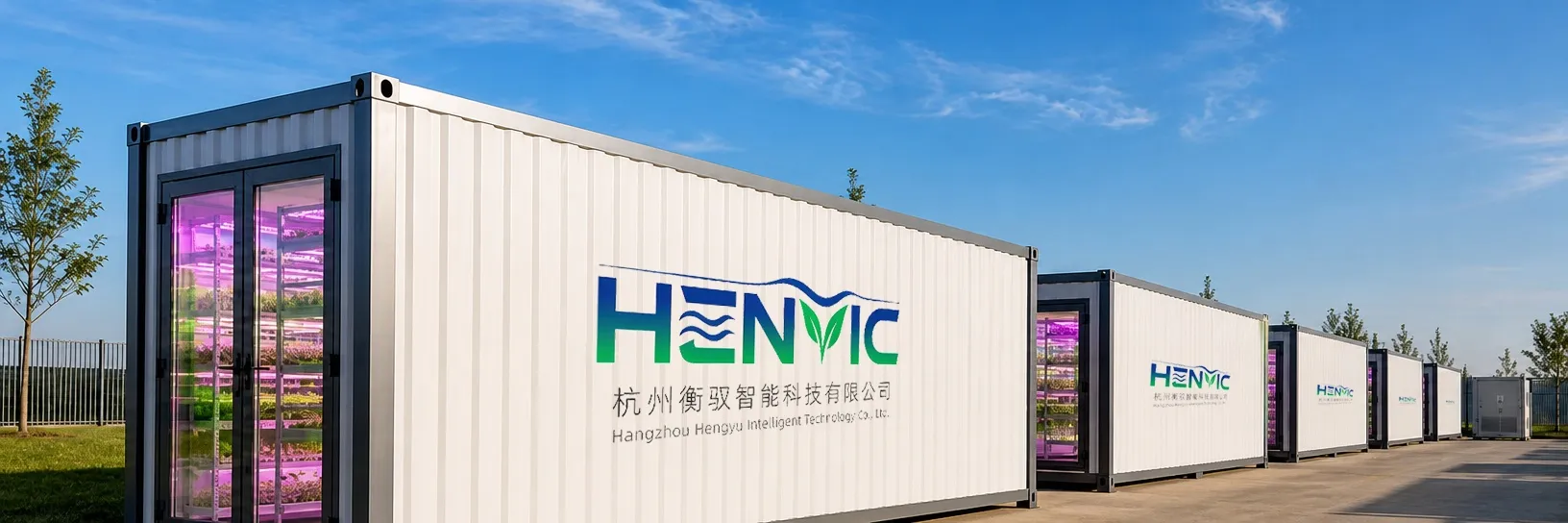
Container vertical farming attracts attention because it is visually compelling and conceptually tidy. It succeeds or fails on arithmetic. The arithmetic is not complicated, but it is unforgiving, and the first step in any serious assessment is to separate the costs that scale with production from the costs that do not.
Capital: what the box actually costs
A turnkey 40-foot container farm from a reputable supplier typically carries a price between roughly 60,000 and 150,000 US dollars, with the upper end reflecting higher tier counts, larger lighting capacity, more sophisticated climate control, automation and vision systems. That figure generally includes the insulated and lined box, the racking and hydroponic channels, the lighting and electrical distribution, the refrigeration plant, the dosing and irrigation system, the controls, and factory commissioning. It does not include shipping to site, site preparation, the electrical service upgrade, the concrete pad or hardstanding, or installation labour, which together commonly add 20 to 40 percent.
The electrical service is frequently the largest hidden cost. A unit drawing 30 kilowatts continuously requires a three-phase supply of adequate capacity, a distribution board, protection, and in many locations a transformer upgrade. In constrained urban sites, the cost of bringing adequate power to the location can exceed the cost of the container itself. This is the single most common reason a project that looked viable on the supplier's pro forma fails at the site survey stage.
Redundancy adds further capital. A standby generator sized for the full load, or a battery system sized for several hours of essential load, is not optional in most commercial installations because a crop loss is total rather than partial.
Energy: the cost that decides everything
Consider a reasonably well-specified leafy-green container with 300 square metres of growing area and a lighting load of 30 kilowatts including drivers. Add circulation fans, the irrigation pump, the dosing system and the controls — perhaps 3 kilowatts. The refrigeration plant consumes roughly 0.3 to 0.5 kilowatts of electrical input per kilowatt of heat removed, and because essentially all of the lighting load becomes heat inside the box, plus latent load from transpiration, the plant must remove more than 30 kilowatts of heat. At a coefficient of performance of 3, that is another 10 to 12 kilowatts.
Total continuous draw lands between 40 and 46 kilowatts. Over a year of continuous operation, that is 350,000 to 400,000 kilowatt-hours. At 0.15 US dollars per kilowatt-hour, the electricity bill is 52,000 to 60,000 dollars annually. At 0.30 dollars, it is over 100,000. In markets where industrial tariffs are low and the climate is cool, the number falls; in markets with high tariffs or the need for aggressive cooling, it rises sharply.
This single line item, more than any other, determines which crops can be grown profitably.
Yield and the per-kilowatt-hour question
A well-run container farm produces, for leafy greens, on the order of 3,000 to 6,000 kilograms per year, depending on crop, number of tiers, and the proportion of the box devoted to growing rather than to aisle and machinery. Cutting yield per square metre is therefore 15 to 30 kilograms per year, which is respectable by field standards but depends entirely on how it was produced.
The metric that actually governs viability is yield per kilowatt-hour. If the box produces 4,500 kilograms per year on 350,000 kilowatt-hours, that is about 78 kilowatt-hours per kilogram of fresh produce. At 0.15 dollars per kilowatt-hour, energy alone costs 11.70 dollars per kilogram. Wholesale lettuce trades at a small fraction of that. The conclusion is inescapable: at commercial electricity prices, container farms cannot compete on commodity crops, and any business plan that assumes otherwise is arithmetic error rather than optimism.
What the arithmetic permits
The crops that clear the threshold share three characteristics: high value per kilogram, perishability that makes freshness a real premium, and a willingness among buyers to pay for provenance or for a specific quality attribute.
Culinary herbs are the canonical example. Basil, coriander, mint and dill sell at 20 to 40 dollars per kilogram in premium wholesale and restaurant channels, are highly perishable, and lose aroma quickly after cutting. A container farm adjacent to its customers can deliver a product that is materially better than what a cold chain delivers, and can charge accordingly.
Microgreens and specialty salad leaves follow the same logic. They turn over in seven to twenty-one days, which means the working capital tied up in a crop is small and the production area is used many times per year — a decisive advantage when the capital cost of the facility is fixed and large. Edible flowers occupy a similar niche.
Propagation is another economically sound application. Seedlings and transplants require precise environmental control, high uniformity, and short residence times, and they are typically moved out to a field or greenhouse before they reach the size at which light becomes the dominant cost. A container propagation unit runs hard for three weeks and then empties, which suits the economics well.
Strawberry and small-fruit propagation, and the production of high-value medicinal or research crops — where uniformity, traceability and freedom from contaminants are worth more than unit cost — are also defensible uses. Pharmaceutical and nutraceutical plant production, in particular, is willing to pay for a documented, reproducible environment in a way that food buyers generally are not.
Channels change the arithmetic more than technology does
A container farm selling into a commodity wholesale market competes with field-grown produce at a fraction of the cost and will lose. The same facility selling directly to restaurants, through a subscription box, or as an on-site amenity for a supermarket, hotel or corporate campus is selling something different: proximity, freshness, traceability and story. Those attributes command a premium, and the premium is often larger than the reduction in cost that any hardware improvement could deliver.
This is not a marketing observation so much as a structural one. The container's fundamental advantage is that it can be placed where demand is, which makes short and direct supply chains possible. Realising that advantage requires a commercial model built around direct relationships rather than a distribution network, because the distribution network consumes exactly the margin that proximity creates.
Simple sensitivity analysis
Three variables dominate the outcome: electricity price, yield per kilowatt-hour, and the realised selling price. A facility with a 0.10 dollar tariff, 65 kilowatt-hours per kilogram and a 25 dollar per kilogram selling price has a plausible business. The same facility at a 0.25 dollar tariff, 90 kilowatt-hours per kilogram and a 12 dollar selling price does not, regardless of how well it is run.
Because all three are only partly within the operator's control, the prudent approach is to model all three simultaneously and to test the project against adverse combinations rather than expected ones. A container farm that only works when electricity is cheap, yields are at their theoretical maximum and prices hold at the top of their range is not a business; it is a wager.
The honest summary
Container farming is not a way to grow food cheaply. It is a way to grow a specific and limited set of high-value crops reliably, anywhere, close to the point of consumption, at a cost that some buyers are willing to pay. The technology is sound and the control it offers is genuine. The economics constrain what can be grown, and any assessment that begins with the hardware rather than with the margin per kilowatt-hour is starting in the wrong place.