The container farm of the future is not merely a box with plants in it. It is an instrumented, networked, and increasingly autonomous system—one that monitors itself, predicts its own needs, and adjusts to changing conditions. This final article looks at the technologies pushing container agriculture toward intelligence, and the sustainability pressures shaping its development.
From Automation to Autonomy
Container farms already rely on automation for irrigation, dosing, and climate control. The next step is autonomy: systems that not only execute setpoints but decide what the setpoints should be. This requires sensing, modeling, and learning.
Sensing is becoming richer and cheaper. Environmental sensors track temperature, humidity, CO₂, and light across the growing space. Inline sensors monitor nutrient solution. Cameras and machine-vision systems assess plant size, color, and health, detecting stress, pests, or disease before a human eye would. These data streams feed a digital picture of the farm's state that no manual inspection could produce.
Modeling converts data into understanding. Crop growth models relate environmental inputs to plant response; climate models predict how the container will react to weather and internal loads; hydraulic models describe solution behavior. Together they let the system anticipate rather than merely react.
Learning refines all of it. Machine learning algorithms trained on historical data identify patterns, flag anomalies, and optimize parameters. Over time, the farm accumulates experience encoded in software—an institutional memory that persists beyond any individual operator.
The Intelligent Growing Environment
In practice, intelligence shows up as tighter, more efficient control. Lighting can be adjusted dynamically to deliver the daily light integral needed while minimizing energy, and spectra can be tuned to crop and stage. Climate control can anticipate weather and pre-adjust, avoiding peaks and overshoot. Fertigation can respond to real-time plant demand. Defrost, cooling, and ventilation can run only when needed.
This level of control turns resource efficiency into an algorithmic problem: deliver exactly what the crop needs, when it needs it, with no waste. The result is lower energy consumption per unit of produce and more consistent quality.
Digital Twins and Simulation
A digital twin—a virtual replica of the farm that mirrors and predicts its behavior—is a powerful tool for design and operation. Operators can test a new crop recipe, a different setpoint, or an altered layout in simulation before committing resources. Digital twins accelerate development, support troubleshooting, and enable predictive maintenance by forecasting equipment failures.
For container farms, where physical space is tight and change is costly, the ability to experiment virtually is especially valuable. It compresses the learning curve that would otherwise be measured in spoiled crops and wasted energy.
The Sustainability Reckoning
Container agriculture's environmental profile is mixed, and honesty about it matters. On the positive side, closed-loop water systems use far less water than field agriculture, land use is minimal, transport distances shrink, and pesticide use can be reduced or eliminated because the enclosed environment excludes many pests.
On the challenging side, energy intensity is high. Lighting and cooling consume substantial electricity, and if that electricity is generated from fossil fuels, the carbon footprint of a container-grown leaf can exceed that of a field-grown one, despite the transport savings. This is the central sustainability question for the industry: can the energy be cleaned up?
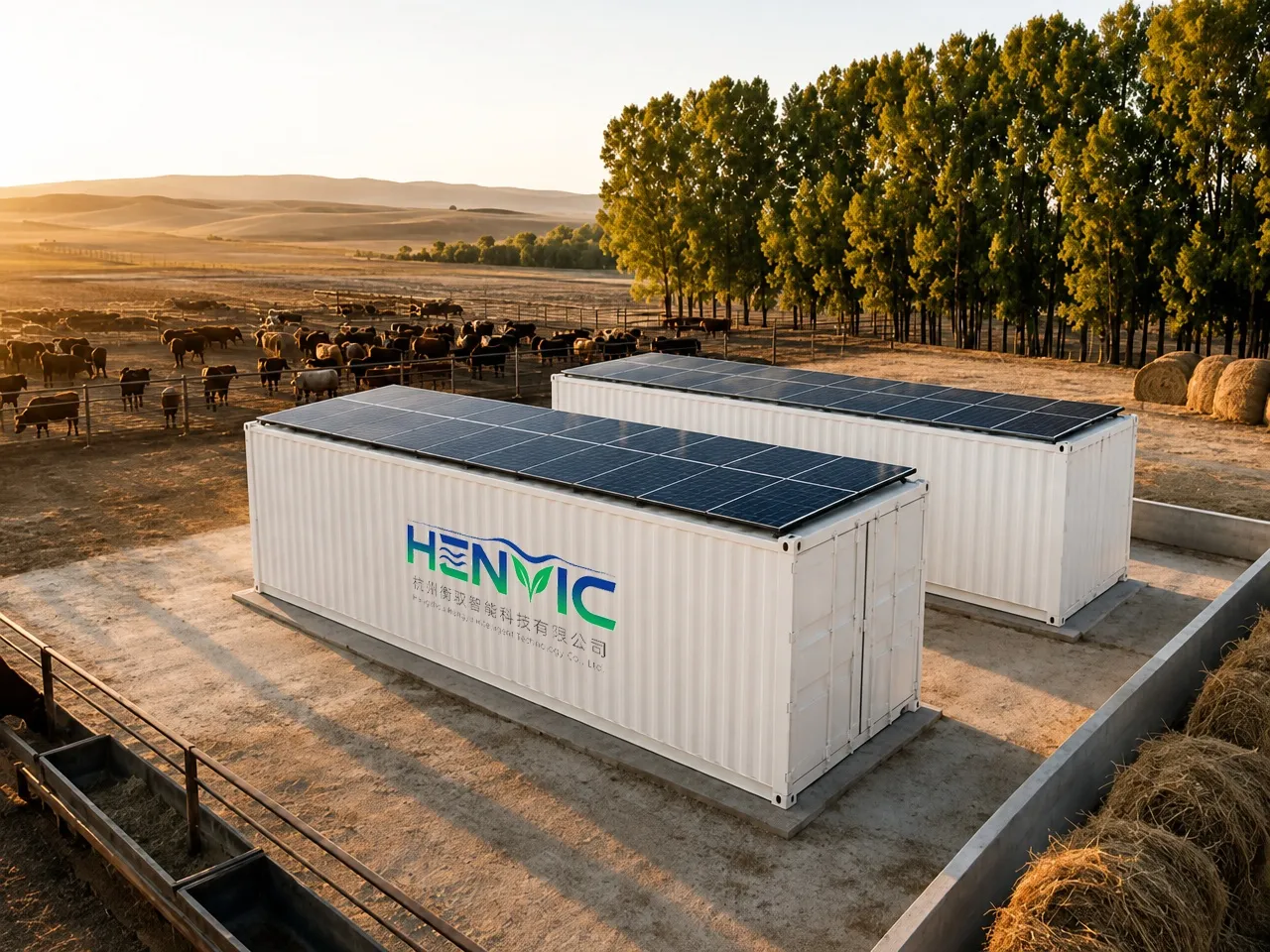
Several responses are emerging. On-site solar generation offsets grid consumption and reduces carbon intensity. Renewable power procurement achieves similar ends at scale. Heat recovery captures waste energy from lighting and refrigeration. Improved LED efficacy reduces the largest electricity load. And efficiency gains in control reduce energy per unit of output. Together, these can shift container agriculture toward a genuinely low-carbon model, particularly where renewable power is abundant.
Refrigerant and material choices matter too. Climate control systems should use low-global-warming-potential refrigerants. Construction materials and growing media should be selected with life-cycle impact in mind. Waste streams—spent media, packaging—should be managed responsibly.
Integration with the Food System
The most transformative potential lies in integration. Container farms can be embedded in supply chains in ways that reduce total system impact. Producing greens within a city shortens the last mile and cuts the cold-chain burden of long-haul distribution. Deploying containers in food deserts improves access without transporting perishables across continents. Coupling container farms with waste-heat sources, such as industrial facilities or data centers, converts a waste stream into a growing input.
At the facility level, integration continues. Production planning aligns with demand to avoid overproduction. Energy management balances loads against tariffs and renewable availability. Quality systems link growing data to product outcomes. The container becomes one node in a smarter, leaner food system.
Looking Forward
The intelligent container farm is not a distant vision; elements of it are already operating. Its hallmarks are comprehensive sensing, adaptive control, digital simulation, efficient and clean energy, and integration into broader systems. The benefits are better quality, lower cost, reduced waste, and a smaller footprint.
None of this changes the fundamentals. Plants need light, water, nutrients, and a suitable climate, and the laws of thermodynamics and economics still apply. What changes is the precision and foresight with which those needs are met. The container farm of the future is still a box—but a box that watches, thinks, and learns. Whether that intelligence translates into prosperity and sustainability depends not on the technology alone, but on how purposefully it is applied to real crops, real markets, and real resource constraints.