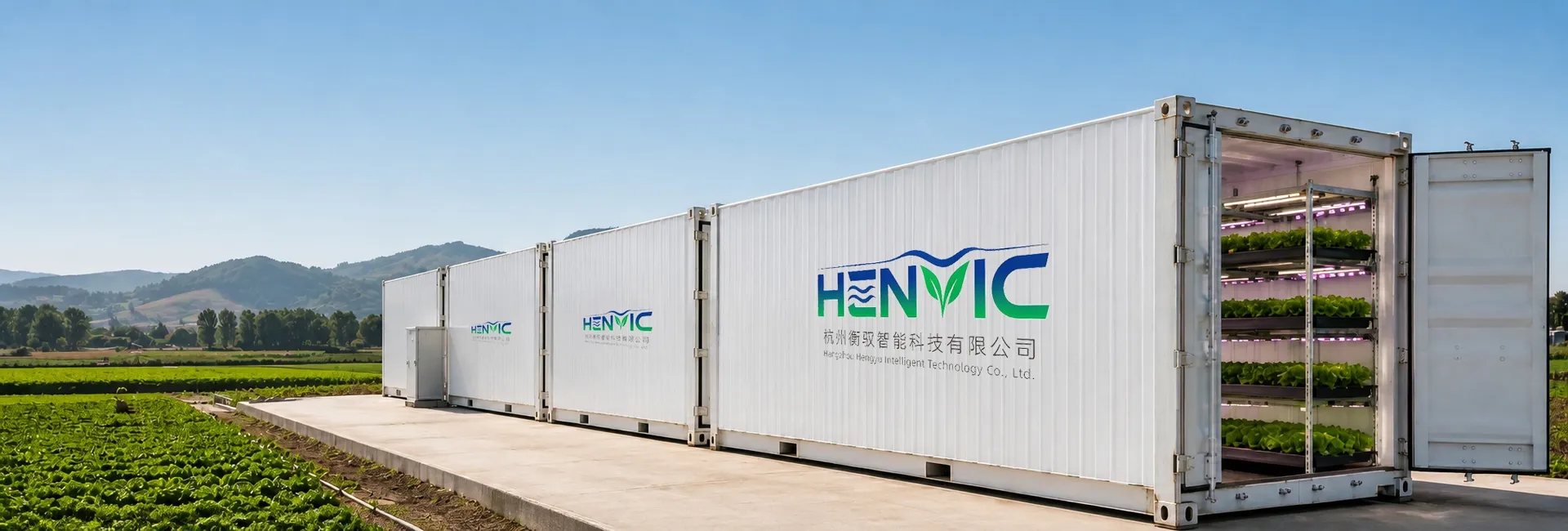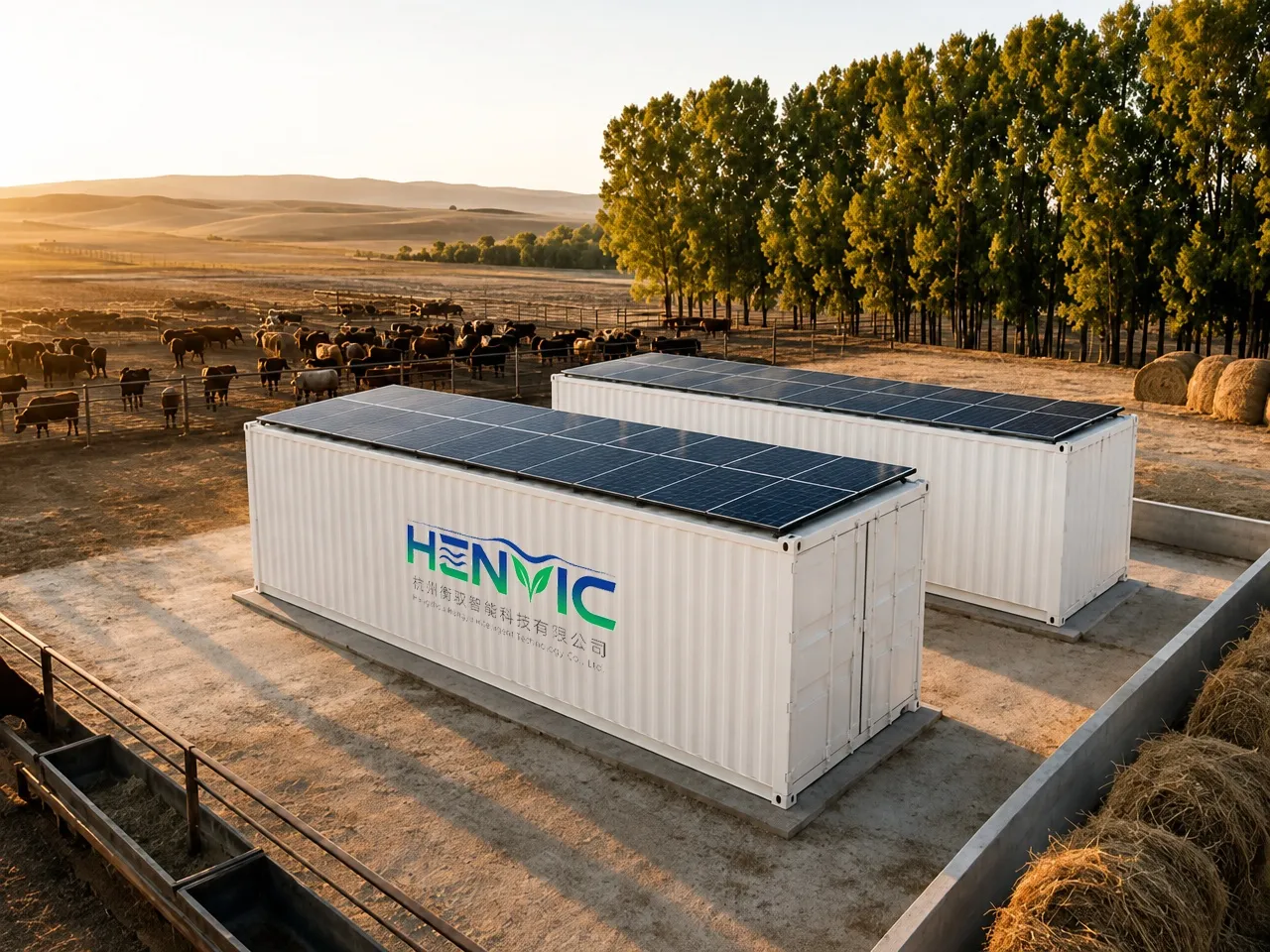
A shipping container is not a greenhouse. That distinction shapes every engineering decision inside a container farm. A greenhouse is designed to admit and modulate natural light; a container is designed to keep the outside out entirely, which means everything the crop needs — light, air movement, moisture removal, nutrient delivery, thermal regulation — has to be generated and controlled from scratch within roughly 67 cubic metres of steel-lined volume. The container's virtue is not that it is a good growing environment. Its virtue is that it is a standardised, shippable, structurally rated enclosure that can be converted into a repeatable production unit. The engineering task is to compensate for everything the container is not.
The Structural Layer
A forty-foot high-cube offers about 2.6 metres of internal height from floor to ceiling, and after insulation, ceiling plenum and rack clearance, the usable vertical space for cultivation typically resolves into five to six tiers. That arithmetic is the origin of the form factor: the container is not tall enough for the deep vertical farms that occupy warehouses, but it is more than tall enough to stack shallow trays at close spacing.
Conversion begins with thermal isolation. The steel shell conducts heat efficiently and condenses moisture readily, so spray foam insulation is applied to walls and ceiling, and a vapour barrier is installed on the warm side. The goal is to break thermal bridges at the ribs and floor edges, where condensation otherwise forms and promotes corrosion. The interior is then lined with food-grade, washable panel — often fibreglass-reinforced plastic or powder-coated steel — so that surfaces can be sanitised between crops.
The floor deserves particular attention. A typical container floor is plywood over steel cross-members and is not designed to be flooded. Operators either seal it with an epoxy coating and drain channels, or install a raised growing deck that keeps spilled water away from the structural substrate and provides drainage below the racks.
The Cultivation Layer
Within the box, the growing system is usually one of four configurations: deep water culture, in which roots float in a shallow pool of oxygenated nutrient solution; nutrient film technique, in which a thin film of solution flows continuously along a sloped channel beneath the roots; substrate culture in rockwool, coco coir or peat plugs, with fertigation by drip; or aeroponics, in which roots are suspended in air and misted intermittently.
The choice is driven by crop, risk tolerance and labour model rather than by an abstract sense of sophistication. Nutrient film technique is efficient and cheap to build but offers very little buffer: a pump failure or a channel blockage can desiccate a crop within hours. Substrate culture is forgiving and suits crops with larger root systems, but generates spent media that must be disposed of or reused. Aeroponics delivers exceptional oxygen availability and fast growth for some crops, at the cost of nozzles that clog and require filtration and periodic service. Container farms tend to favour the configurations with the fewest failure modes, because there is no room in a container for redundant systems.
The Light Layer
In a sealed box, lighting is the dominant design constraint and the dominant operating cost. Every photon the crop receives is purchased. This pushes design toward high-efficiency light-emitting diodes, tunable across the red and blue portions of the spectrum with adjustable ratios and, increasingly, some inclusion of far-red and green wavelengths for morphological control.
Mechanically, the lighting layer interacts with everything else. Fixtures are mounted close to canopy to reduce wasted light, which means heat is delivered directly into the crop zone and must be exhausted by the climate system. Fixtures must be rated for high humidity and for washdown. Wiring and drivers are typically placed in a service corridor or external cabinet so that heat and electrical risk are removed from the grow volume.
The Environmental Layer
The climate system in a container is doing several jobs at once. It must remove the latent load — the water vapour transpired by the plants, which for a mature leafy crop can amount to litres per day per unit area. It must remove the sensible heat generated by the LED fixtures and by the fans and pumps. It must maintain temperature and humidity setpoints within tight tolerances so that vapour pressure deficit stays in the band where stomata function properly. And it must do all of this without introducing external air that would bring in pests, spores or pollen.
The standard architecture is a split or packaged air-conditioning system with enhanced dehumidification capability, combined with internal air circulation fans that keep the canopy boundary layer in motion. Carbon dioxide enrichment is often added, since a sealed volume will be depleted of CO₂ as the canopy photosynthesises during the light period; dosing is typically maintained somewhere between ambient and 1,200 parts per million, depending on crop and safety practice.
Control, Water and the Service Edge
Above these layers sits the control system: a network of sensors for air temperature, humidity, light intensity, CO₂, solution temperature, electrical conductivity and pH, feeding a controller that modulates dimming, cooling, dehumidification and fertigation. Data logging is now standard, and it is what turns a container farm from a piece of equipment into a managed production asset.
Finally, the service edge. A container farm needs a water supply (often with reverse-osmosis pre-treatment to control alkalinity and avoid mineral accumulation), a drain or recirculation loop, a power feed of substantial capacity, and a data connection. In cold climates the unit may need external insulation or a vestibule. In hot climates the condensing unit needs shade and airflow. These unglamorous details are frequently the reason a container farm underperforms its specification: the box is engineered, but the site is not.
The container is a shell. What makes it a farm is the disciplined stacking of six interlocking systems, each of which constrains the others. Getting them to coexist inside 67 cubic metres — without a service corridor for maintenance access, without the option of opening a vent to dump heat, without room for redundancy — is the actual engineering problem.