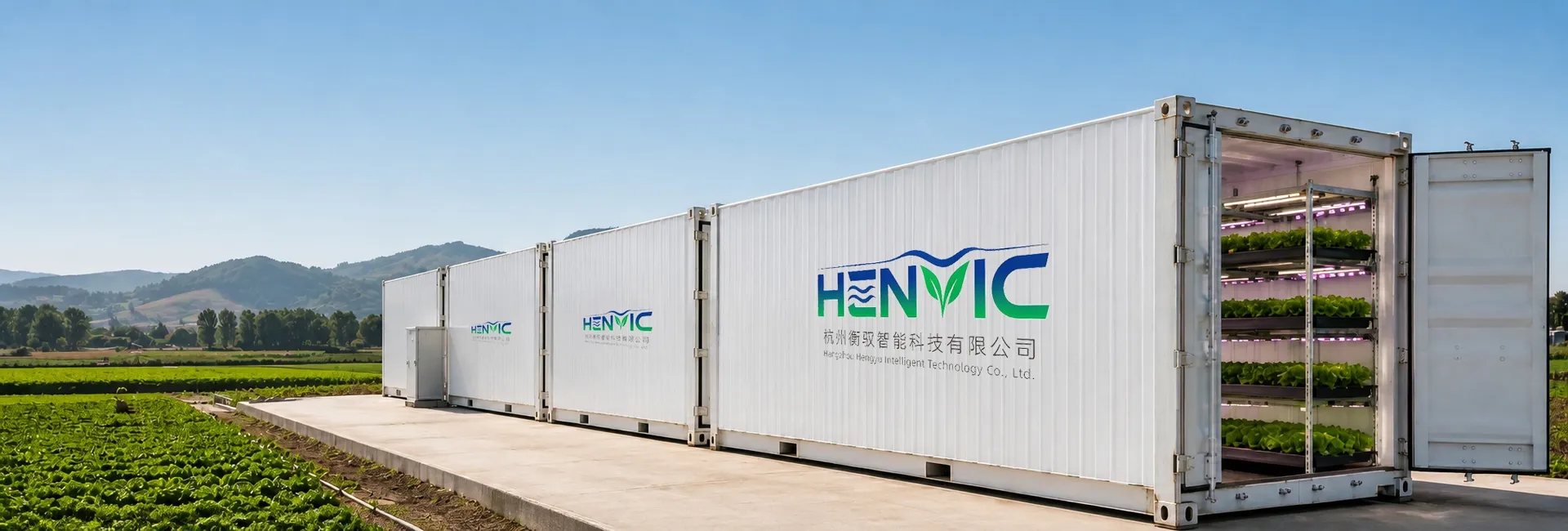
In an open field, light is free but uncontrollable. In a greenhouse, light is free but supplemented. In a container farm, light is neither free nor supplemented: it is the single largest energy input, the dominant driver of equipment selection, and the parameter that most directly determines both yield and operating cost. Designing the lighting layer well is therefore the central discipline of container farming.
Why Light Is Different Here
A mature crop canopy needs a substantial daily light integral, conventionally expressed in moles of photons per square metre per day. In a sunny field in summer, that figure is abundant. Indoors, every mole must be supplied by fixtures whose wall-plug efficiency is finite. As light-emitting diode technology improved, the efficiency of converting electricity into photosynthetically usable photons roughly doubled over a decade, which is what made container farming commercially conceivable at all. Even so, the energy cost of lighting remains the floor under a container farm's cost of production.
This has a structural consequence: container farms are economically viable only for crops with short cycles and high value per kilogram. A crop that takes four months to mature cannot amortise the lighting energy. A crop that sells for a few cents per kilogram cannot either.
The Spectrum Question
Plants respond to wavelength differently. Chlorophyll absorbs strongly in the blue and red regions, with peaks roughly in the 430 to 450 nanometre and 640 to 670 nanometre ranges. Early indoor systems therefore used narrow-band red and blue diodes almost exclusively, on the theory that photons outside the absorption peaks were wasted energy.
That theory has been substantially revised. Green photons are absorbed less efficiently by chlorophyll but penetrate deeper into the canopy, reaching lower leaves that red and blue light cannot. Far-red photons, around 730 nanometres, are largely outside the photosynthetic action spectrum yet drive the Emerson enhancement effect and exert strong control over plant morphology — stem elongation, leaf expansion and the shade-avoidance response. Crops grown under red-and-blue only often display compact, thickened, sometimes distorted growth that looks efficient but yields less biomass than anticipated.
The practical result is that modern container farm spectra include a defined red-to-blue ratio, a modest green component for canopy penetration, and a controlled far-red fraction used deliberately as a morphological tool, sometimes applied only at the end of the photoperiod to influence expansion without sacrificing photosynthetic efficiency.
Intensity, Photoperiod and Daily Light Integral
Spectrum is only half the story; the other half is how much light and for how long. Daily light integral, the product of instantaneous intensity and photoperiod, is the quantity that correlates most closely with yield. A grower can reach a target integral with high intensity over a short photoperiod, or lower intensity over a long one, and the two are not equivalent. Long photoperiods reduce plant dark-respiration losses but risk photoperiodic disruption in some species and increase the fraction of the day during which cooling is required. High intensity concentrates the light period and can allow the climate system to be sized differently, but demands careful canopy management to avoid leaf scorch and to ensure lower leaves receive light.
Practically, container farms tend to run photoperiods of 14 to 18 hours for leafy greens and herbs, with intensity tuned so that the daily integral lands in a range the crop tolerates without tip burn, bolting or tissue abnormality. Headroom matters: as fixtures are moved closer to the canopy, intensity at the leaf rises and the lit area shrinks; some operators raise fixtures as the crop grows to maintain uniform intensity across the footprint.
Thermal Coupling and the Energy Loop
The defining inefficiency of container farming is the lighting-heating-cooling loop. Light-emitting diodes convert most of their input electricity to photons, but the remainder becomes heat, and the photons themselves are eventually absorbed and converted to heat in the leaf. In a sealed box, all of that heat must be removed by the cooling system. The grower pays for the electricity to run the lights, then pays again for the electricity to remove the heat the lights produced.
This loop makes fixture efficiency and thermal management inseparable from cost. A more efficient diode reduces both the lighting bill and the cooling bill, which is why lighting upgrades produce a double return. Mounting drivers remotely, so their waste heat is rejected outside the conditioned volume, produces a smaller but similarly doubled saving. In cold climates, operators can sometimes redirect fixture heat to offset building heating, effectively converting the loop into a benefit for part of the year.
Uniformity, Reliability and Practicalities
Two properties of a lighting installation matter beyond raw efficiency. The first is uniformity. A lighting plan that delivers twice the intensity at the centre of a rack than at its edges produces uneven growth, uneven maturity and a harvest that must be graded and partially discarded. Photometric layout, reflector design and fixture spacing all bear on this, and the standard practice is to measure the distribution on an empty rack before the crop goes in.
The second is reliability. A fixture failure in a container farm is not merely a yield nuisance; if it persists through a light period, the affected zone receives a reduced daily light integral that cannot be recovered. Fixtures must be rated for the humidity and condensation they will experience, sealed against washdown, and monitored so that failures surface immediately rather than at harvest.
Where the Technology Is Heading
Three trends are visible. First, continuing gains in diode efficiency, which compound across both the lighting and the cooling line items. Second, dynamic spectral control, in which the ratio of wavelengths is varied through the photoperiod or across the crop cycle rather than fixed at commissioning — an approach that requires better crop response models than currently exist but is already used commercially for specific crops. Third, coordination between lighting and climate strategy: rather than treating light as one system and cooling as another, controllers increasingly schedule dimming, cooling capacity and carbon dioxide dosing together, exploiting the fact that light-driven transpiration is what the dehumidification system must clear.
Lighting in a container farm is not a fixture purchase. It is an energy commitment, a thermal load, a morphological signal and a determinant of harvest uniformity, all at once. Treating it as such is what separates a farm from a box of lamps.